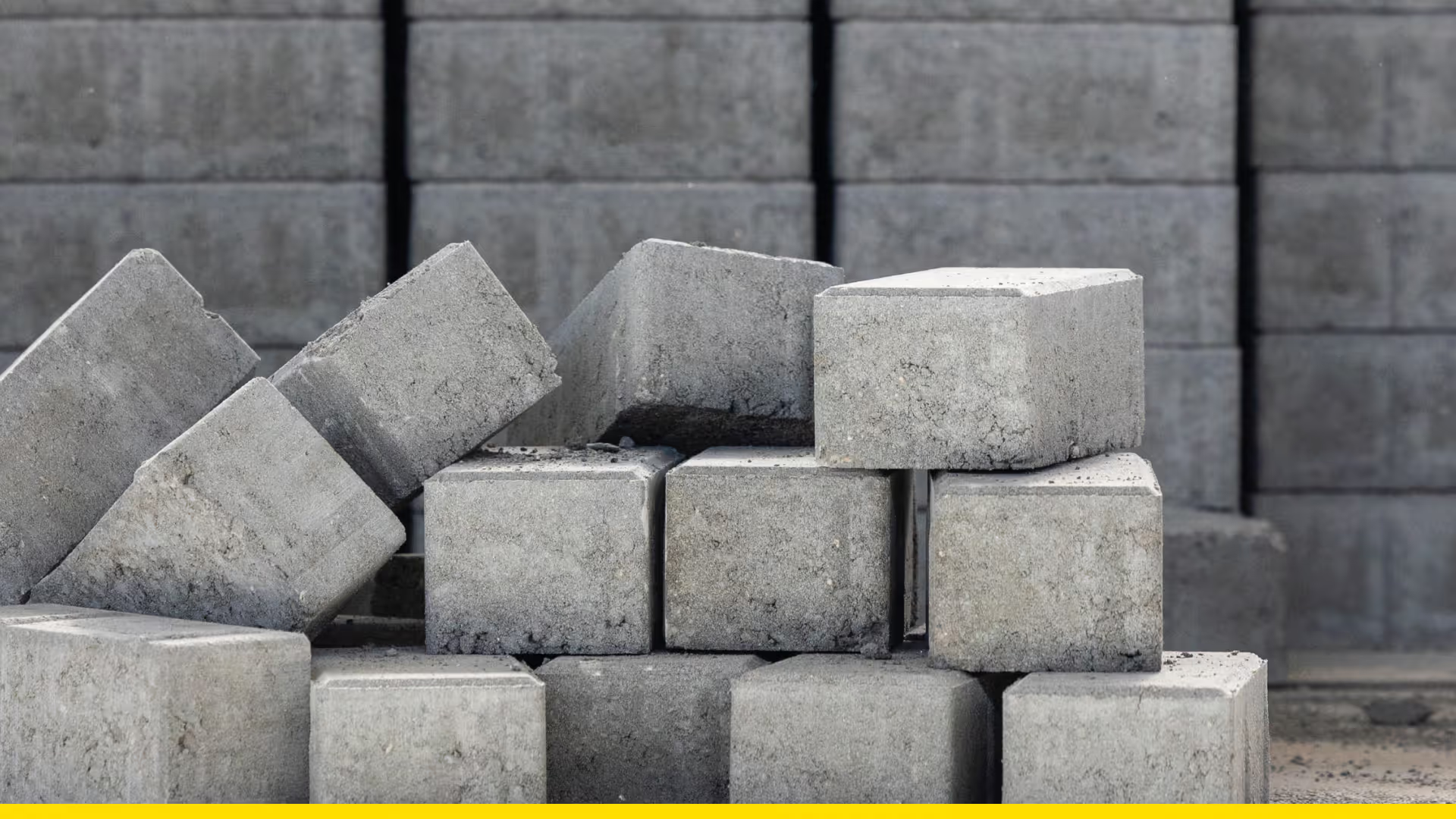

A well-made paving stone base is the key to a beautiful look and durability of the pavement.
It is difficult to imagine a beautiful and well-maintained yard or outdoor public space without neat paved paths, sidewalks and areas paved with paving stones or paving slabs. But in order to prevent them from sagging and losing their attractive appearance, it is important to know how to lay paving stones correctly.
An indispensable step in the process of paving is the preparation of the base for paving stones. This technological process requires appropriate knowledge and skills to ensure that the final result will serve for a long time and reliably.
The base for paving stones is a kind of "pillow" on which the decorative coating is laid. It consists of sand, crushed stone, a mixture of sand and cement, and can also be additionally reinforced with reinforcing mesh.
It is clear that before you can buy paving stones and start laying them, you need to carry out design work, even if it is not a large public facility but a small private yard. First of all, you need to measure the area to be paved, calculate the load on the surface, find out the existing drainage conditions, or plan for it.
At this stage, you also need to calculate the amount of materials needed.
This stage is extremely important and responsible, because not only the future appearance of the pavement, but also the durability of the paving stones depends on the quality of its execution. So we explain how to make a base for paving stones.
Before creating the foundation, it is necessary to clearly define the boundaries of the area to be paved and the height of the future pavement. To do this, stakes are driven into the ground and a construction line is stretched to mark the top edge of the pavement.
The next step is to remove the topsoil in the area where the paving stones are to be laid. The depth of removal is determined by the thickness of the paving elements and the so-called paving cushion, and ranges from 30 to 50-60 centimeters. When removing the soil layer, you need to pay attention to the groundwater level and, if present, take care of the drainage system. Keep in mind that the ground under the base needs to be additionally tamped to prevent it from sagging under load in the future.
Then the site is profiled, i.e., its boundaries are outlined, taking into account roundings, bumps, and turns.
The thickness of the cushion under the paving stones depends on the load that is planned for the area in question:
Please note that in the process of arranging the base, it is necessary to carefully level and tamp certain layers using a vibrating plate
This stage involves the installation of curbs to reinforce the contours of the pavement. The trench for their installation should be deeper than the base and 20 cm wider than the curb itself. Its bottom is tamped and covered with a layer of sand (2-3 cm), semi-dry concrete (10-20 cm) and cement-sand mixture (2-3 cm). The curbs are installed on the cement mortar.
This step should be started from the curbs to the center. Use a building level to ensure that the pavement does not have any slopes, deflections, or differences. Upon completion of the work, it is necessary to fill the seams. It is carried out using dry white sand. Do not forget to renew the filling between the paving elements over time, because in the course of life, sand is washed away from precipitation and washing of paving stones.
One of the options for laying paving stones is to lay them on a concrete base. Typically, such a cushion is used in industrial areas and in areas with increased stress on the surface.
In this case, the laying technology is somewhat simpler: after the concrete base is ready, a layer of sand-cement mixture is poured onto it, leveled, and the paving stones are laid.
In fact, paving areas with paving slabs is not an easy task and requires not only theoretical knowledge but also professional skills and tools. Therefore, in this matter, it is always better to trust professionals who know how to lay paving stones beautifully.
At the same time, your understanding of how to properly lay the foundation for paving stones will allow you to avoid unnecessary costs and control the quality of the work in stages.
