.avif)
According to the consulting company Pro-Consulting, in the first half of 2024, the construction market recovered to about half of its pre-war level. The main activity is in the non-residential sector: industrial facilities, logistics complexes, and industrial buildings.
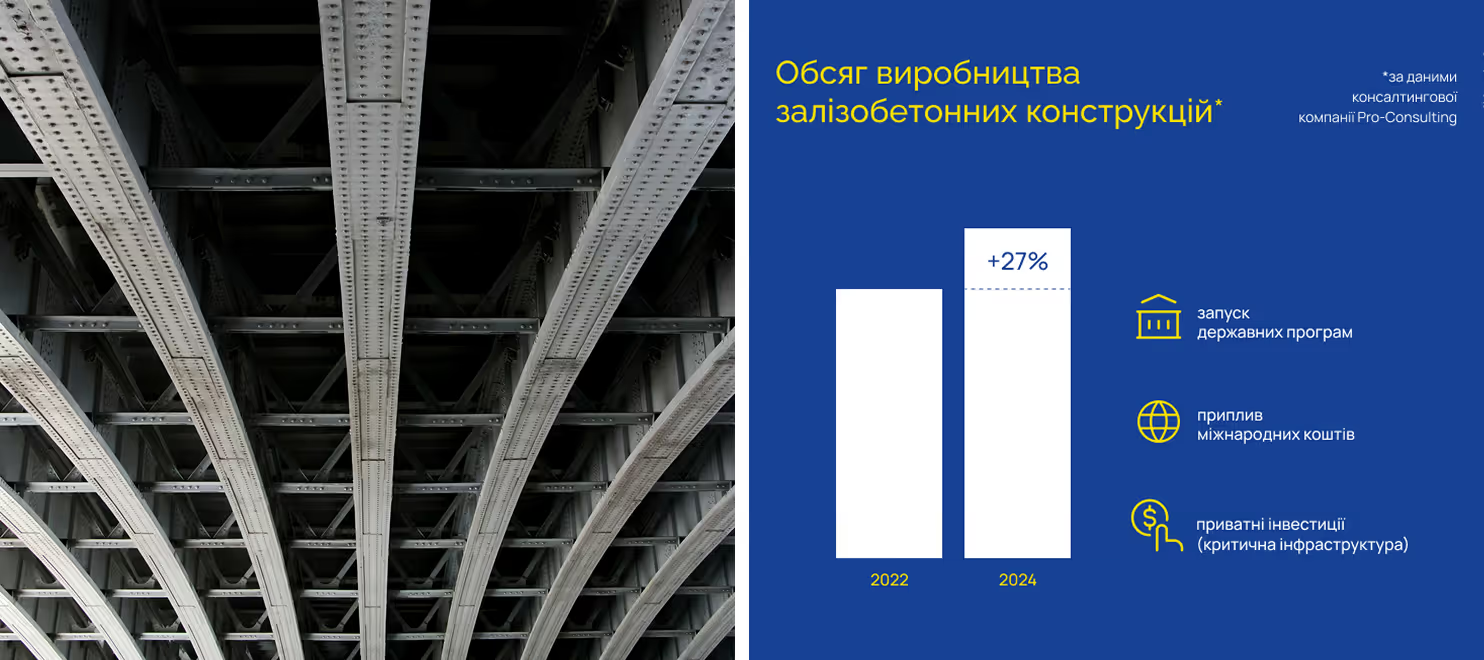
On the back of a gradual recovery in the construction market, the production of reinforced concrete structures increased by 27% compared to 2022 and reached 1.9 million tons. This was driven by the launch of government programs, an influx of international funds, and private investment in critical infrastructure projects.
At the same time, the regional structure is changing: demand is shifting to the west of the country. Lviv, Kyiv, Vinnytsia, Ivano-Frankivsk, Zakarpattia, and Ternopil regions are the main regions of reinforced concrete consumption, accounting for more than two-thirds of domestic production.
Currently, the demand for reinforced concrete in Ukraine is focused on floor slabs, girders, columns, bridge beams and piles, as well as fortifications. There is growing interest in prefabricated structures as a tool for rapid construction in conditions of limited resources and tight deadlines. At the same time, the use of reinforced concrete products in the road transport sector has decreased many times over, as the volume of these construction works in 2023 did not reach even a third of the pre-war figures.

The full-scale invasion has had a significant impact on the industry: construction priorities and the logistics of supplying raw materials and finished products have changed. At the same time, the sector is adapting to new challenges. Demand is shifting toward projects that require reliable and durable materials.

Changes in the design of residential buildings, in particular, with the mandatory arrangement of shelters in them, have led to the use of high-strength concrete and reinforced reinforcement to increase the reliability of structures. "There is also a growing need for fast installation, as many facilities are being built under tight deadlines," says EFE CEO Shan Isajan.
EFE responded to new challenges back in 2022. Over the past two years, the company has invested more than $34 million in expanding production capacity, modernizing equipment, and automating processes. One example is the CGM machine, which allows for the automatic production of reinforced concrete structures using vibroforming.
"We recently purchased a Schnell 3D rebar bending machine with a capacity of 8 tons per day, which allows us to replace 25 employees at the same time," adds Shan Isajan.
This is not automation for automation's sake, but specific solutions that allow for stable and predictable operations. We talked more about EFE's experience on the way to automation in an earlier publication.
For EFE, the production of bridge girders remains a key area of focus, which plays an important role in infrastructure reconstruction. As a part of ONUR GROUP, the company continues to actively grow this segment.
The industry needs an honest conversation about numbers, regions, pace, challenges, and new infrastructure. That is why such publications are important - not for showcasing, but for understanding who and how the industry is moving forward today.
You can read more about current trends and market prospects in the full ProfBuild article here.
